Barrister, geologist, historian and local government campaigner
By Bessie White
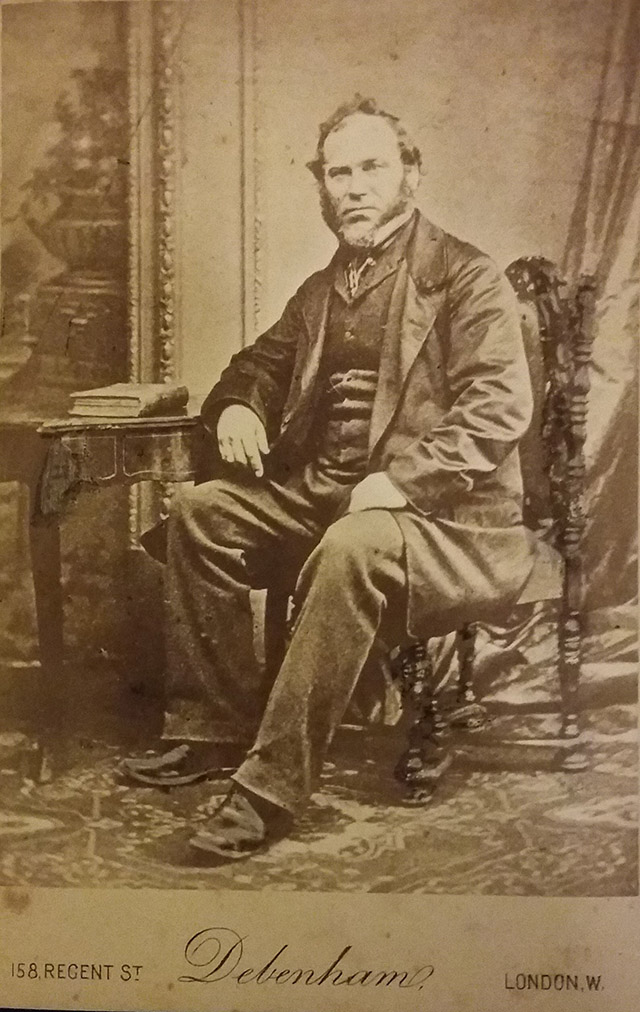
Early life
Joshua Toulmin Smith was born in 1816 in Birmingham to a Unitarian family. His father was William Hawkes Smith, author, draftsman and lithographic printmaker. He was given his name – Joshua Toulmin Smith – in honour of his great grandfather on his mother’s side, Joshua Toulmin, a renowned theologian and dissenting preacher.
He was educated initially at home and then at a school in Hale in Cheshire, near Manchester, run by Charles Wallace, minister of Hale Unitarian Church. Aged 16 Joshua was articled to Arthur Ryland, a local Birmingham solicitor, but clearly continued other studies. Aged 17 he wrote ‘An Introduction to the Latin Language’ for a class at the Mechanics Institute, and aged 20, ‘Progress of Philosophy of the Ancients’.1
In 1835 he moved to London and was entered at Lincoln’s Inn with a view to becoming a barrister. However, life then took a different turn.
American journey
Very shortly after his marriage in 1837 to Martha Kendall, the couple travelled to the United States, staying in Detroit, Utica in New York State and Boston where the first two of their children, Lucy and William, were born.
In America Toulmin Smith lectured on philosophy and phrenology. Phrenology is the pseudoscience popular at the time which claimed that a person’s personality, intelligence and thus even economic prospects could be predicted by the shape their skull had developed since birth.
The frontier life in America without the ‘conveniences of civilisation’ was not for them. Despite a warm welcome from some individuals, they returned to England in 1842.
However, Toulmin Smith made the most of his time in the States. In 1839 he had published in London ‘The Discovery of America by Northmen in the Tenth Century’2, a book inspired by Danish Professor Rafn’s publication on early Icelandic voyages to America. Joshua pointed out that the accepted belief that America was ‘discovered’ by Christopher Columbus is not actually the truth. Norsemen had travelled there much earlier, even if settlements did not survive.
London life
On their return to London Joshua and Martha chose Wood Lane, Highgate as their home. He continued with his legal studies and was called to the bar in 1849. He and Martha arrived went on to have another four children. Of the six, five reached adulthood.
After Joshua’s untimely death in 1869, Martha and her daughters remained based in the family home. It was only after her death in 1887 that the house was sold. Lucy, the oldest of the children then moved to Southwood Lane, still in Highgate. This remained the base for her two sisters when they were in England until 1894 when Lucy took up an appointment in Oxford. None of the daughters married.
Geological interests
It’s likely that it was in the 1840s that Toulmin Smith moved on from phrenology to geology. His interest was specifically in fossil sponges. This led to the publication of a monograph titled ‘The Ventriculitidae of the Chalk’ which was published in various articles in the ‘Annals and Magazine of Natural History’ in 18473 and 18484.
Joshua’s work was innovative in that he used a microscope to define species of sponges rather than describing examples by shape as done earlier. After his death, Martha sold a large part of his collection of fossils to the Natural History Museum which even now forms an important part of their collection. She also donated his scrap book to the Museum, which contains corrected proofs of his papers in which some 20 new species were named.
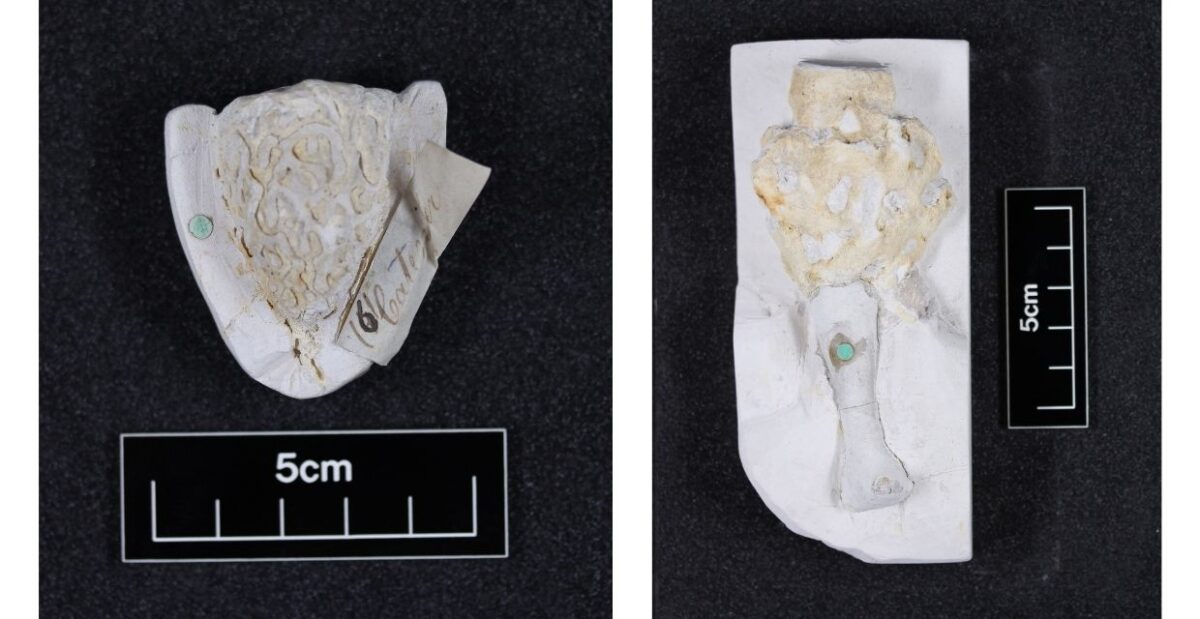
There is of course one caveat to note in Joshua’s articles on geology. They were clearly pre-Darwinian, i.e. still assuming that all plant life as seen in fossils was fixed rather than might have evolved over time. In his paper ‘The Ventriculitidae of the Chalk: their classification’ he comments in a footnote, “Forms like this [a feature of Cephalites retrusus] afford very strong ground of caution against the hasty adoption of any development theories. We see a Unity which [does not point to ] a necessary or probable progressive development of one form from another…”.5
Whether or not species evolved was by this time a subject of debate, with prominent scientists arguing both sides of the issue.6
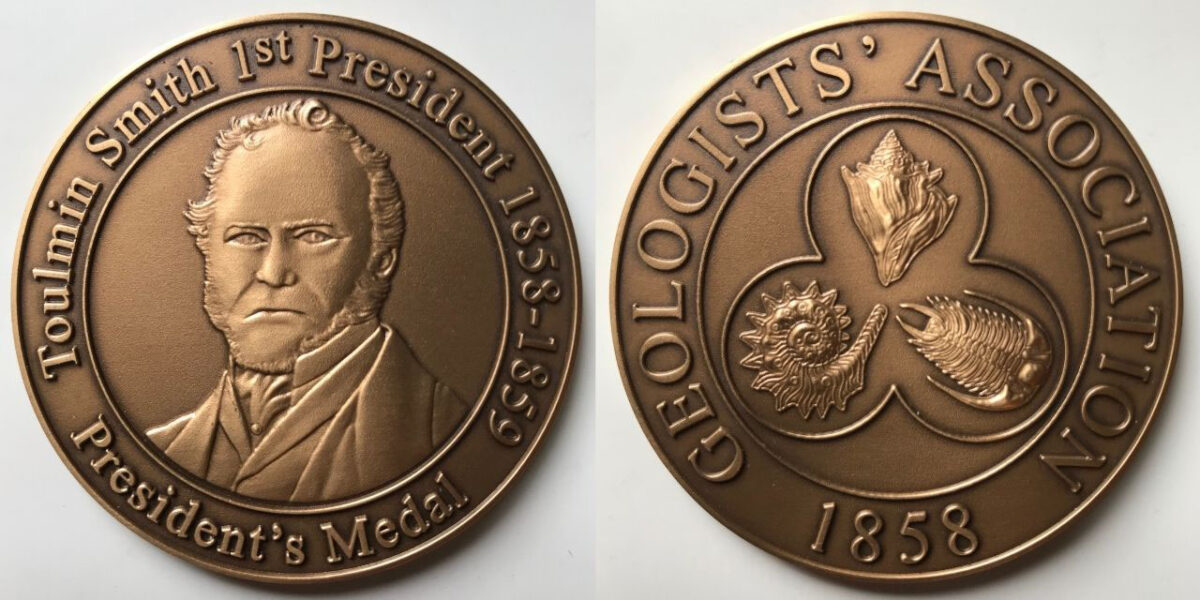
With his energy and eagerness for knowledge it was not surprising that in 1858, Toulmin Smith was a driving force behind the proposal to form a Geologists’ Association for ‘intercommunication and mutual help’ for ‘learners’ as an alternative to the already established Geological Society which appealed more to professional geologists. Toulmin Smith was among the founding members and served as its first President, giving his inaugural address titled ‘The Finding of True Facts’ on 11th January 1859. However he stated in his address that due to his other interests, he did not think he had the time required for the role of President which he felt was necessary. It’s possible also that he lacked the temperament required for committee work. He withdrew after only a couple of months in the role.7
The Geologists’ Association are proud of their first president. In 2017 they inaugurated a new award, The President’s Medal. This is given for long-service contribution to the continued administration and benefit of the Geologists’ Association which is run, even now, almost entirely by volunteers.
Public affairs and government
In 1847 there was a cholera outbreak in London and the following year the first Public Health Act was passed, establishing a Central Board of Health and enabling local borough corporations, where they existed, to assume responsibility for drainage, public water supplies and so on. Toulmin Smith strongly opposed this, arguing that local self-government was ‘the sole effective basis of both freedom and happiness’. In his view, such public responsibilities should continue to be provided locally, not by arbitary word of the state.
He also argued for a widening the franchise to include artisans, but not to the propertied middle classes who would, in his view, make decisions on the basis of their own vested interests rather than the common good of the local community.8 Serving on the Hornsey Sanitory [sic] Committee, he researched the law and practice of local responsibilities for public health, publishing ‘The Laws of England relating to Public Health’ in 1848. Other publications include ‘Local Self-Government and Centralisation’ in 1851, followed in 1854 by ‘The Parish and its Obligations and Powers’. That same year he served as first Chairman of the Hornsey Highways Board.
For three years from that same year, 1854, he and two others ran a group they called the Anti-Centralisation Union.
He also took an interest in bills being debated in Parliament. His concern about what he saw as increasing state interference in areas of both public and private life led to his production, weekly, between 1857 and 1865, of the Parliamentary Remembrancer. This was a record of bills and other papers to be presented, with his commentaries based on historical research and his own views. It was available by subscription of a guinea per parliamentary session.9
Other interests
In between his domestic research, Joshua took an interest in the Hungarian campaign of 1848/9 for independence from an autocratic state, the Austro-Hungarian Empire, led by Lajos Kossuth. Kossuth stayed with Joshua and Martha at Wood Lane on a visit to London.10 In 1861 Joshua defended Kossuth in a court case brought against him by the Austrian government.
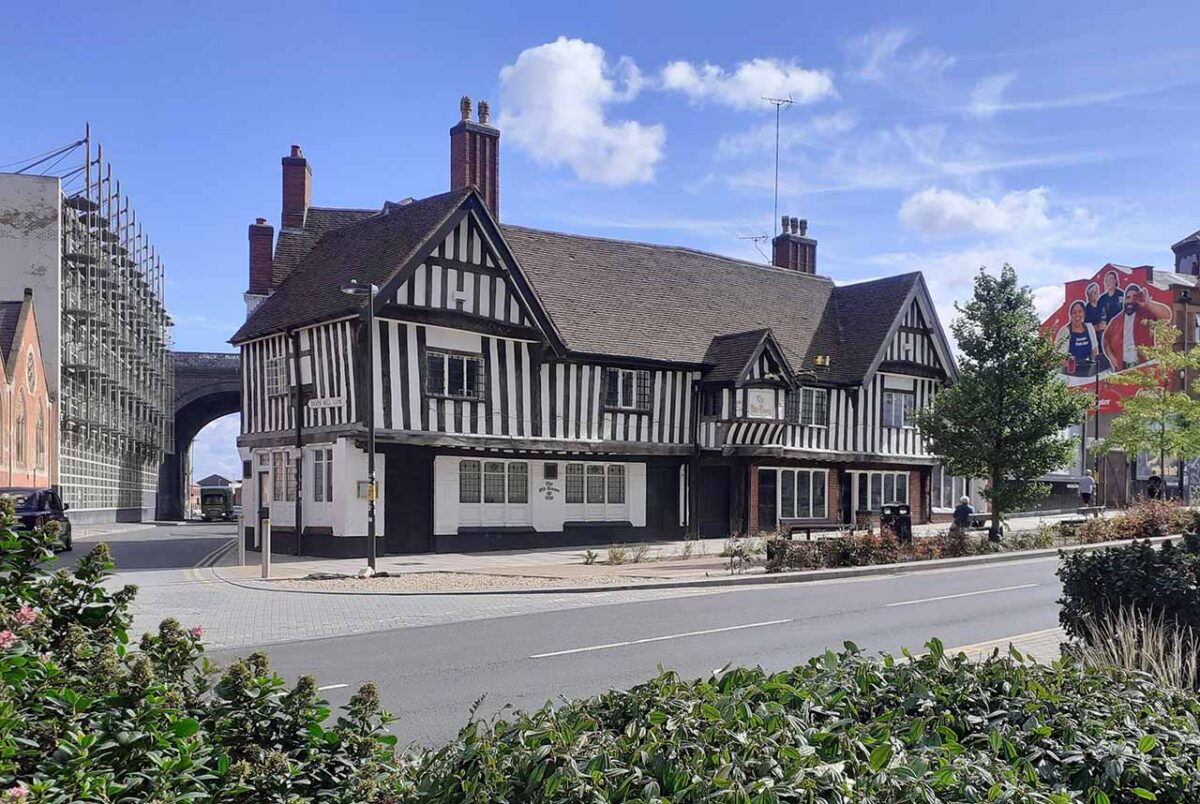
On a different topic, his historical researches and publications included Birmingham, his birthplace. He published the ‘Memorials of Old Birmingham’ and also the ‘Traditions [i.e. History] of the Old Crown House’.
The Old Crown House is said to be the oldest medieval building in Birmingham, originally even 14th century, although probably the present building dates from the early 16th century. He three times successfully prevented Birmingham Corporation from demolishing it for road widening. The building is now listed Grade II* by English Heritage. After a period of near dereliction in the mid-20th century, redevelopment of the Deritend area of central Birmingham has allowed it to return to use and it is now a flourishing pub.
It seems that apart from his time with the Anti-Centralisation Union, Joshua probably worked alone, except that he had a growing family and he certainly engaged his two oldest children early as helpers, Lucy and William three years her junior. Sadly, William died unexpectedly in 1851, aged 10. Joshua felt the loss deeply: “with him, are cut off many of the most fondly-cherished hopes of many years of happy promise”.
Toulmin Smith himself died in April 1869 swimming at Lancing in Sussex, where he had gone for a recuperative break. A final project he was working on when he died was a study of the ordinances of the medieval English Gilds based on original documents he had found in the Public Records Office. This project was completed by Lucy with a commentary, and introduction and published in 1870 by the Early English Text Society.
Aftermath
Joshua Toulmin Smith was buried in St Mary’s graveyard Hornsey, along with young William and his widow Martha who died in 1887. Of his five surviving children, the most academic and well respected by other scholars was Lucy Toulmin Smith. She worked as a freelance researcher, mainly on medieval texts. She also did work for James Murray, the first editor of the Oxford English Dictionary. Other independent research and editorial work included ‘The York Mystery Plays’ published with detailed notes and a glossary by Clarendon Press in 1885. This remained the standard edition until the 1980s. Another was ‘The Itinerary of John Leland’ in or about the
Years 1535-1543 published in 5 volumes in 1906.
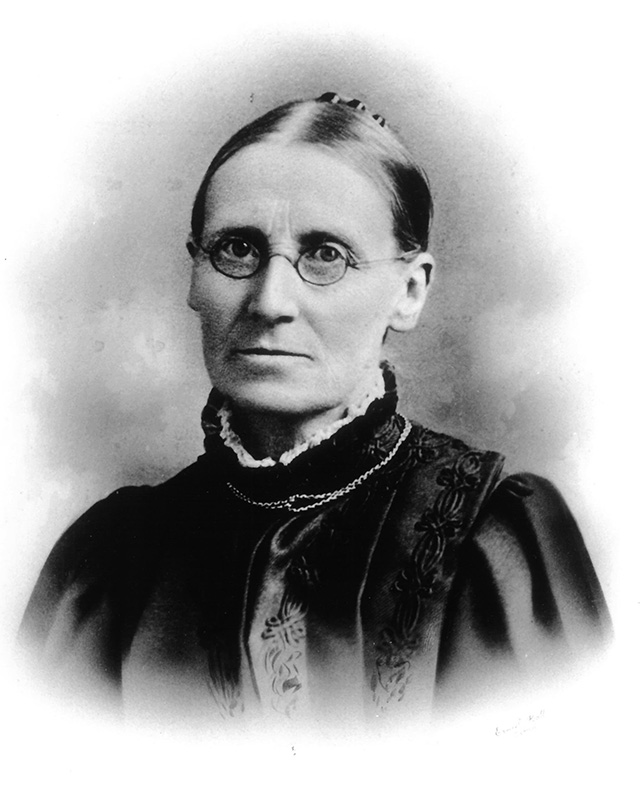
In 1894 Lucy moved from Highgate to Oxford to take up appointment as librarian of Manchester College, now Harris Manchester, a Unitarian establishment. When she retired in 1911, the Committee noted ‘her eminent literary abilities, sufficiently attested by the scholarly works which she had produced, have conferred distinction upon the College which she has served with such punctuality and faithfulness.’ Sadly, she died a month later.
Her brother Arthur was an engineer. He spent his life in Russia, first installing the telegraph in the Caucasus and then running his own engineering business Ludwig and Smith.11
Joshua’s younger son, Alfred Toulmin Smith, was a solicitor. He married Lillian Thomasina Meade (pen name LT Meade), who wrote popular literature, much of it aimed at girls and young women.
A second daughter, known as Elly, was an artist, resident for much of her life in Montpellier. The youngest daughter, Fanny, also took an interest in Russia and learnt enough of the language to be able to take a job for a time teaching English in a girls’ school in St Petersburg. She published an article, ‘Girls Education in Russia’, in the ‘Girls Own Paper’.
- Introduction to Toulmin Smith’s Journal to America 1838 – 1839 (Michigan Historical commission, 1925) https://babel.hathitrust.org/cgi/pt?id=uiuo.ark:/13960/t24b3637c&seq=11 ↩︎
- Available here https://archive.org/details/discoveryofameri00smi/page/n7/mode/2up. Toulmin Smith’s edition is in what he calls ‘conversational style’ similar, he states, to Plato or Cicero. A straightforward history of the same subject ‘The Pre-Columbian Discovery of America’ by the Northman by B F de Costa was published by Joel Munsell’s Sons Publishers, Albany NY, in 1890. https://archive.org/details/precolumbiandisc00dec/page/n5/mode/2up. ↩︎
- ‘Annals and Magazine of Natural History’, nos 123 – 129,1847 January 1847, pp 1 and 287
https://www.biodiversitylibrary.org/item/19465#page/11/mode/1up and op cit nos 130 – 136, pp73 and 334 August 1847 https://www.biodiversitylibrary.org/item/19465#page/391/mode/1up ↩︎ - ‘Annals and Magazine of Natural History’ – including zoology, botany and geology, Vol 1, second series, 1848, p36, 203, 285 and 352.
https://www.biodiversitylibrary.org/item/72155#page/300/mode/1up ↩︎ - https://www.biodiversitylibrary.org/item/72155#page/300/mode/1up ↩︎
- https://archive.org/details/evolutionremarka00lars ↩︎
- A fuller history of the founding of the Geologists’ Association can be found in an article in the Magazine of the Geologist’s Association, Vol. 7 No ,1 2008. ↩︎
- Claus, Peter Mark (1998). ‘Real Liberals’ and Conservatives in the City of London, 1848-1886, p 64. ↩︎
- Copies of Volumes 1 – 7 of the Parliamentary Remembrancer can be found online here
https://books.google.tg/books?id=c6YOAAAAQAAJ . Accessed 22 05 2026. ↩︎ - Schwitzer, Joan. Buried in Hornsey. The graves of St Mary’s churchyard. n.d ↩︎
- Arthur Toulmin Smith A British Engineer in 19th Century Russia Bessie White 2025 Troubador Publishing. Book based on Arthur’s letters home to his sister Lucy. ↩︎
Image credits
Joshua Toulmin Smith, author’s collection
Syntype of the sponge Oncolpia elegans found by Toulmin Smith from the Upper Chalk of Southern England. Image © The Trustees of the Natural History Museum, London
Syntype of the fossil sponge Toulminia catenifer collected by Toulmin Smith in the South Downs
of Southern England. Image © The Trustees of the Natural History Museum, London
The two sides of the GA President’s Medal, image courtesy of the Geologists’ Association
The Old Crown House, author’s collection
Lucy Toulmin Smith, photographer Ernest Hall, image courtesy of Harris Manchester College